
Hydrodynamic modelling
Detailed current and water level information from hydrodynamic modelling is one of our key activities.
We use professional commercial and open-source modelling packages: MIKE 21 FM, MIKE 3, Delft3D and D-Flow FM. Hydrodynamic studies provide the tidal and wind-driven currents and water levels needed for design, morphological studies and navigation studies. We have developed regional and detailed flow models for, among others, the Arabian Gulf, Mediterranean Sea, Gulf of Thailand, Bay of Bengal and North Sea, to establish design and operational current and water level criteria.
What we model
Hydrodynamic model studies are carried out for:
- Design water levels (tide, wind set-up)
- Cyclone hindcasting
- Operational conditions
- Input to navigation and mooring studies
- Water circulation
- Advection and dispersion
- 3D effects
- Tsunami propagation
Wadden Sea hindcast
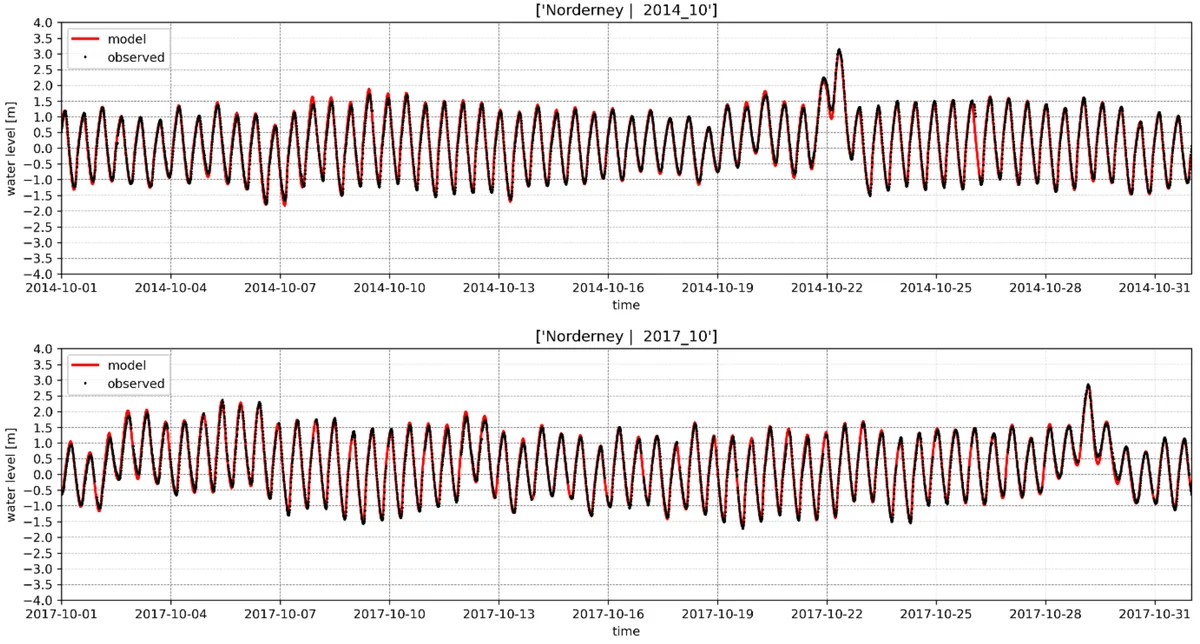
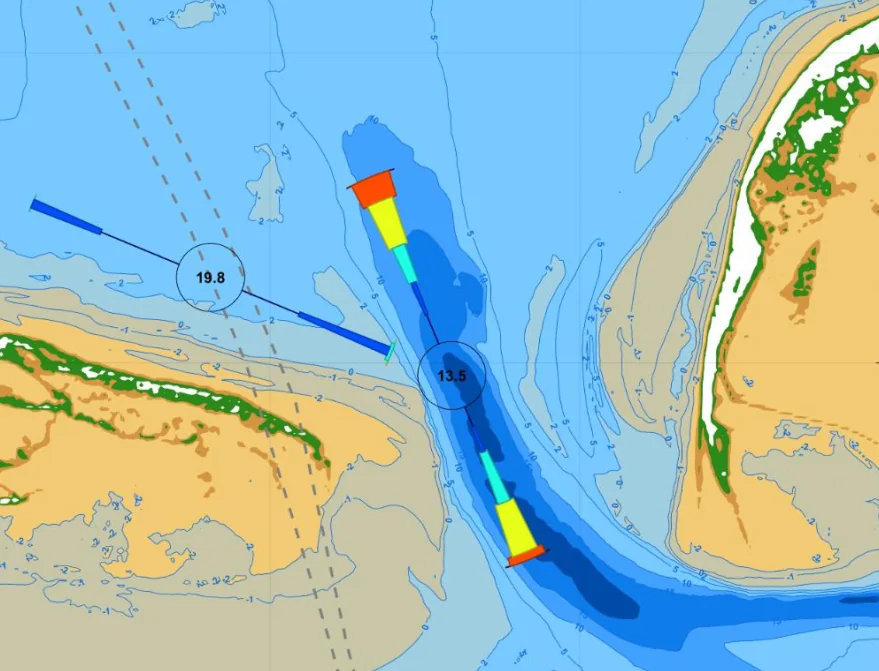
We have developed a high-resolution wave and flow hindcast for the Wadden Sea. The area is highly complex: a shallow tidal sea with many channels, tidal flats and inlets between the barrier islands, where the flow is steered by the bathymetry.
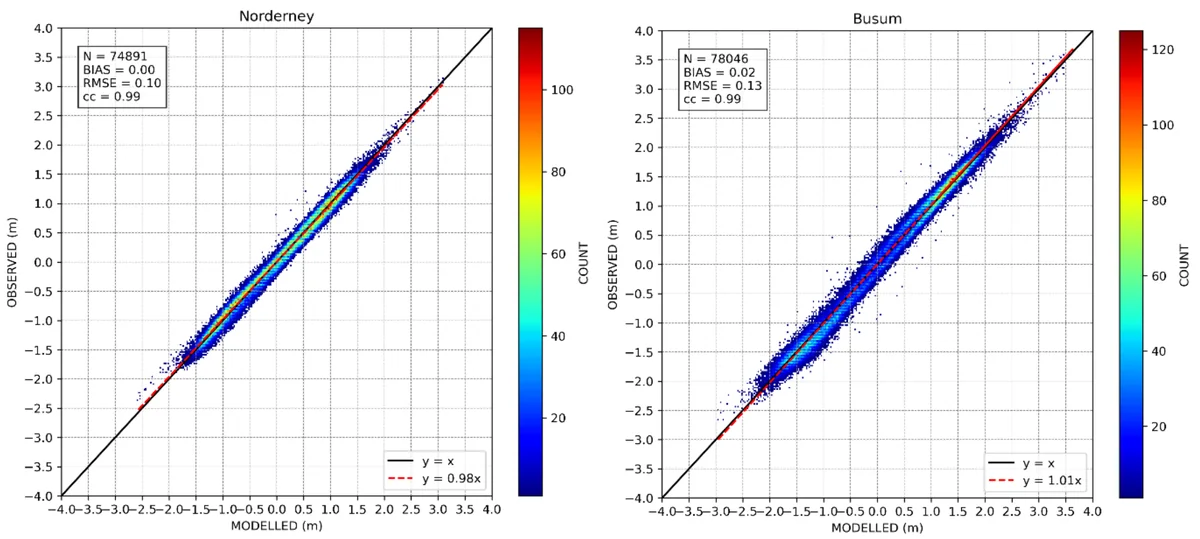
The model grid follows the channels in detail, so water levels and currents are reproduced with high accuracy. At the tide gauges of Norderney and Büsum, for example, the bias is 0.02 m or less, the RMSE 0.10 to 0.13 m and the correlation 0.99.
2D and 3D models
Besides 2D modelling, we carry out 3D studies with our MIKE 3 licence. For a detailed 3D current study in the Lombok Strait, for example, we used 3D ocean salinity, temperature, water levels and current velocities from HYCOM.
MIKE 21 FM can run its computations on the GPU, which makes it one of the fastest commercially available hydrodynamic modelling tools, and it couples wave and flow models smoothly.
Flexible meshes
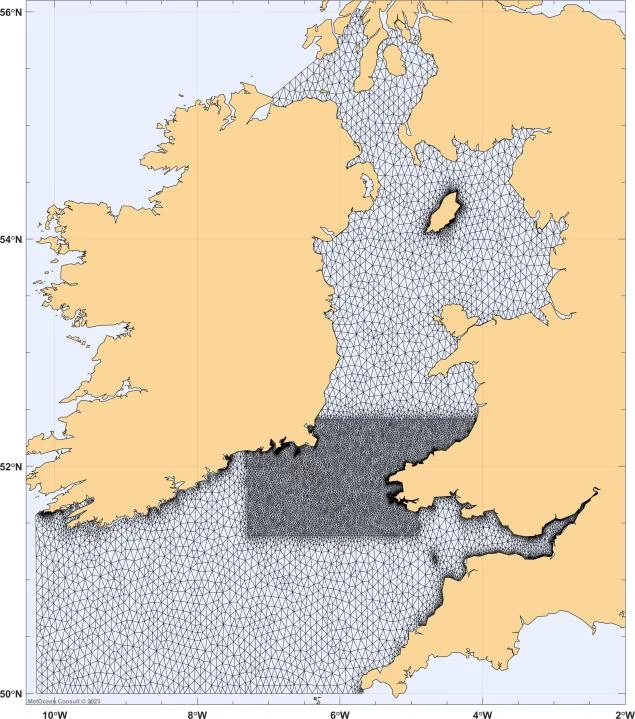
D-Flow FM, the successor of Delft3D developed by Deltares, combines different mesh types in one model grid: regular grids, triangles and curvilinear elements, in 1D, 2D and 3D. This lets us optimise model grids for speed and accuracy in the most complex situations. As an early adopter and beta tester of D-Flow FM, we have worked with it from its first releases.
← All services · Questions? marco [at] metoceanconsult.com · +31 6 3310 2554